Saylor Names Solana And Ethereum As Future Of Digital Credit

bitcoinistPublished on 2026-02-27Last updated on 2026-02-27

Abstract

In his keynote at Strategy World 2026, Michael Saylor outlined a vision where Bitcoin serves as the foundational capital base for digital credit products, with Solana and Ethereum acting as key distribution platforms. He explained that his company, MicroStrategy, is shifting from merely accumulating Bitcoin to converting it into structured credit products like its Stretch (STRC) offering. This approach aims to extract steady yield from Bitcoin’s volatility and deliver it as programmable financial instruments. Saylor emphasized that digital credit can be tokenized and distributed across various platforms—including traditional exchanges like NASDAQ and crypto networks like Solana and Ethereum. He argued that if Bitcoin appreciates significantly, it can back large volumes of investment-grade credit. Solana and Ethereum are positioned not as the reserve asset but as scalable rails for deploying tokenized credit, yield, and liquidity products to a broader market.

Michael Saylor used his Strategy World 2026 keynote on Feb. 25 to argue that Bitcoin-backed “digital credit” is moving beyond Wall Street wrappers and toward programmable distribution on crypto rails, naming Solana and Ethereum as part of that future. The pitch matters because it pushes Strategy’s Bitcoin treasury model into a broader product thesis: use Bitcoin as the capital base, then package credit, yield and liquidity for corporates, retail investors and eventually tokenized markets.

Bitcoin Capital, Credit Product

Saylor framed Bitcoin as the foundation of the stack and Strategy’s Stretch (STRC) as the credit layer built on top of it. In his telling, the company’s business is no longer just accumulating Bitcoin, but “converting capital into credit” by using long-duration capital structures to strip cash flow from a volatile asset and deliver it as a steadier yield product.

“What is Strategy doing? Our company is converting capital into credit. We’re converting economic wealth into a stream of cash flows,” Saylor said. “You need an operating company in order to take a block of economic energy and turn it into a currency, peg it to a currency, strip away the risk, damp the volatility, extract the cash flows in the form of yield and compress the duration to now.”

That framework sits at the center of his case for STRC. Saylor said Strategy arrived there only after working through what he described as increasingly durable forms of leverage, from exchange leverage and margin loans to senior debt, junior debt, convertibles and preferred structures.

The key variable, in his view, is not just headline maturity, but the “stochastic duration” of capital, how long a company can realistically rely on it before covenants, mark-to-market stress or refinancing pressure force a problem.

He argued that variable preferred credit offered the best compromise short of common equity because it maximized optionality and reduced the risk of getting squeezed out of the position during a drawdown.

Saylor also laid out a simple quantitative case for digital credit. Strategy, he said, uses three internal metrics: BTC rating, or collateral coverage; BTC risk, the probability that collateral falls below required levels by the end of the term; and the implied credit spread needed to compensate investors. He contrasted current benchmarks of 78 basis points for investment-grade bonds and 288 basis points for high-yield debt with what he said digital credit could deliver if Bitcoin compounds faster than traditional assets.

His model depends heavily on a constructive view of Bitcoin’s long-run returns. If Bitcoin appreciates at 30% annually, Saylor said, sizable volumes of investment-grade credit can be created against it. If Bitcoin goes nowhere, the same structure starts to look like distressed debt.

He used recent performance to sharpen that distinction. Since Bitcoin’s all-time high about four and a half months ago, Saylor said, Bitcoin had fallen 45%, while STRC had lost “0% of its value” and paid 4.5% in dividends through the drawdown. That, he argued, is the commercial opening: offer a less volatile yield instrument to buyers who want Bitcoin-linked economics without owning the asset outright.

Solana And Ethereum As Distribution Rails

The keynote’s most consequential turn came when Saylor described digital credit as “programmable.” He was not using the term narrowly.

“Programmable means I take the credit and I create it. I turn it into a token, a private fund, a public fund, an ETF, an ETP. I make it a bank account. I make it a crypto account,” he said. “Then I put it on a platform — the NASDAQ, the London Stock Exchange, Solana, Ethereum, Binance, Coinbase Base. There are a lot of different platforms I can put that on.”

He went further, arguing that once credit is packaged as a modular product, issuers can tune volatility, liquidity, staking periods, payout frequency and currency exposure. In that framework, Solana and Ethereum are not the capital base (Bitcoin remains that in Saylor’s model) but potential rails for distributing tokenized versions of the credit product.

That leaves Strategy with a larger ambition than simply selling preferred stock. Saylor said the company intends to deepen STRC liquidity and scale the underlying asset base, while partners build “digital money” and “digital yield” products around it.

If that thesis holds, Strategy is betting Bitcoin-backed credit can move from a public-market niche into a cross-platform product category spanning brokerages, ETFs and on-chain ecosystems.

At press time, Solana traded at $86.97.
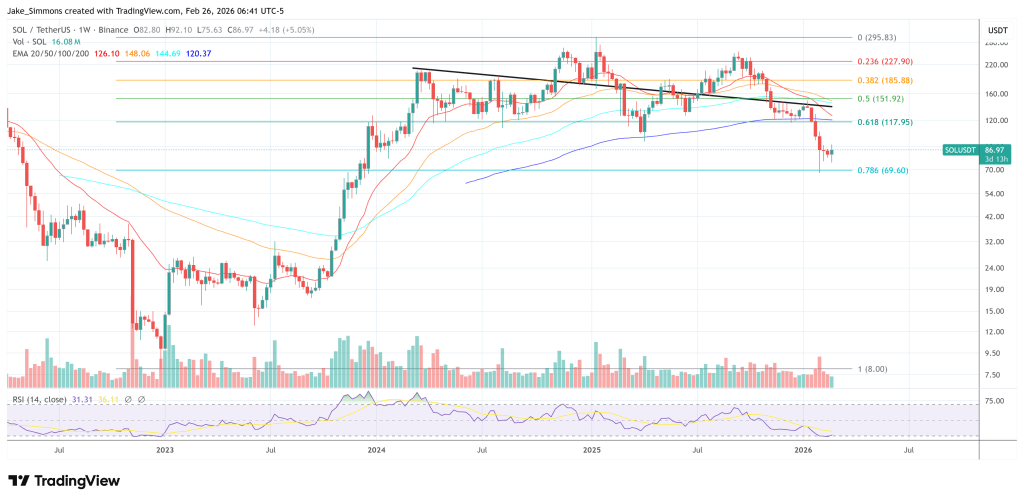
Solana must reclaim the 0.618 Fib, 1-week chart | Source: SOLUSDT on TradingView.com

Related Questions

QWhat did Michael Sayer name as the future platforms for distributing programmable digital credit?

AMichael Saylor named Solana and Ethereum as future platforms for distributing programmable digital credit.

QAccording to Saylor, what is the role of Bitcoin in MicroStrategy's new business model?

ASaylor framed Bitcoin as the foundation of the capital stack, with MicroStrategy's Stretch (STRC) acting as the credit layer built on top of it. The company is converting capital into credit to create steadier yield products.

QWhat three internal metrics does MicroStrategy use to evaluate its digital credit model?

AThe three internal metrics are: BTC rating (collateral coverage), BTC risk (the probability collateral falls below required levels), and the implied credit spread needed to compensate investors.

QHow did Saylor contrast the performance of Bitcoin and STRC during the recent drawdown?

ASaylor stated that since Bitcoin's all-time high, it had fallen 45%, while STRC had lost '0% of its value' and paid 4.5% in dividends through the drawdown.

QWhat is the broader ambition for MicroStrategy's Bitcoin-backed credit, beyond selling preferred stock?

AThe broader ambition is to deepen STRC liquidity, scale the underlying asset base, and have partners build 'digital money' and 'digital yield' products, moving it from a public-market niche into a cross-platform product category spanning brokerages, ETFs, and on-chain ecosystems.

Related Reads

Anthropic Ban Controversy, OpenAI's Hundred-Billion Financing Dispute: What Is the Overseas Crypto Circle Discussing Today?

In the past 24 hours, the crypto market has witnessed a range of discussions from macro trends to ecosystem-specific developments. Key topics include the controversy over AI and national security boundaries, debates around OpenAI's record $110 billion private fundraising, and the potential impact of AI tools on tech employment. Anthropic refused a Pentagon request to remove safety restrictions on autonomous weapons and mass surveillance in its models, leading to a terminated $200M government contract and a divided public response. OpenAI secured massive funding from investors like NVIDIA and Amazon, though its significant losses sparked concerns about a potential tech bubble. Block's 70% engineering team layoffs, attributed to AI efficiency gains, intensified debates on AI's effect on jobs. In ecosystem news, Ethereum community showed optimism as Vitalik Buterin outlined a roadmap with specific timelines for ZK-EVM integration by 2026-2027. Morpho outperformed AAVE, with some attributing it to simpler governance. Solana integrated with SoFi bank, enabling 13.7M users to hold SOL directly. Base ecosystem saw experiments with AI Agents for trading and social interactions. Other notable events included Paradigm's planned $1.5B fund expansion into AI and robotics, Bitwise's XRP ETF application, and OpenAI firing an employee for insider trading on prediction markets. Hyperliquid emerged as the only profitable Digital Asset Treasury project, and regulatory discussions around prediction markets continued.

marsbit50m ago

Anthropic Ban Controversy, OpenAI's Hundred-Billion Financing Dispute: What Is the Overseas Crypto Circle Discussing Today?

marsbit50m ago

Gas Fees and Transaction Security: Avoiding Asset Drainage by Malicious Contracts

Blockchain transactions require gas fee as fuel, but malicious actors exploit this mechanism to drain assets through deceptive practices. Common traps include: 1) Unlimited token approvals, where users grant open-ended access to smart contracts, enabling unauthorized transfers; 2) Gas fee hijacking, where attackers manipulate transaction parameters or embed infinite loops to force excessive gas payments; 3) Fake approvals/transactions via phishing sites that mimic legitimate dApps to steal assets. Key preventive measures: - Apply minimal approval principles, authorizing only necessary token amounts and revoking unused permissions. - Manually set gas limits and prices using wallet advanced settings, avoiding defaults during high network congestion. - Verify contract addresses, transaction details, and DApp authenticity before confirming any transaction. - Use separate wallets for daily interactions and large holdings to isolate risks. If compromised: - Immediately freeze the wallet and revoke all suspicious approvals. - Preserve evidence (TxID, contract addresses) and report to platforms. - Seek professional assistance for large losses—avoid paying "recovery fees" (common secondary scams). Recommended tools: Approval checkers (e.g., Revoke.cash), block explorers (Etherscan), and real-time alert systems. Stay vigilant by scrutinizing every transaction and rejecting unsolicited links.

marsbit2h ago

Gas Fees and Transaction Security: Avoiding Asset Drainage by Malicious Contracts

marsbit2h ago

Trading

Spot
Futures
活动图片